
On April 6, 2020, while I was living in Japan, I visited Rinko. Rinko is a 69-year-old woman living in Chofu, which is at the southern tip of the main island of Japan. Rinko works at a convenience store several days throughout the week and lives in an apartment that looks like any normal Japanese apartment. There is a genkan at the entrance for placing shoes, the doors are of the sliding type, and everything is well-kept and neatly arranged. However, there is a way in which Rinko differs from most Japanese citizens. She is a member of a minority religion called Sukyo Mahikari.
Rinko has been a member of this religion for 40 years. 15 years ago, she became inactive in her membership, but maintained her belief during that time and has recently started practicing again. Growing up, Rinko wasn’t religious but had heard a lot about the gods of various religions and other figures such as Jesus and the Buddha. She wanted to know if a god really exists and who sent those great spiritual leaders to Earth. Jesus, Buddha, and others were in human form according to the scriptures, but she wasn’t interested in worshiping a human. Rinko didn’t believe that a human could create a human; so, these people couldn’t have been gods. Who was this non-human that created the world?
One day some years later Rinko attended a tea ceremony class. There she started talking to a fellow student who described to her a different kind of religion, called Sukyo Mahikari. This religion teaches that there is an ultimate god that sent all of the great religious leaders to Earth. Hearing this greatly touched Rinko’s heart. This is the answer that she had been searching for. She also learned from the student that members are able to heal others by projecting a light from their hands.
This healing light is one of the main practices of the religion. Members are able to raise one of their hands with the palm facing near a person or object and project an invisible light. This light is the power of God and can be used to heal anything negative. She showed pictures of Jesus and Buddha as they are often depicted; with a hand raised and palm facing forward. This, according to believers of Sukyo Mahikari, is proof that the ultimate god sent these great people. Soon after Rinko became a member, she performed the light healing upon her family members. She projected the light on the feet of her younger sister to heal pain. She also performed healing upon her dad’s lower back and a tumor in her mother’s head. Everyone felt relief from their pain and so they all decided to become members of the religion.
The main purpose of projecting light from an outreached hand isn’t to heal; that is only secondary. The light from God has the purpose of cleansing sins. Everyone has lived multiple lives in the past and, in each of those lives, has accumulated many sins. Members of the Sukyo Mahikari religion are trying to save people from this state. Anyone is accepted to receive this healing power, no matter the current religion in which they believe. This is God’s hope and plan to create a world without any sin. A proof of this power and plan is that the giver of the light gains an even better feeling than the receiver.
Another belief has to do with the negative events that occur in the world. Whenever a major disaster occurs, such as a flood, it is intentional. It is a warning from God to humans as a way to tell them to no longer commit sins. God gives members of Sukyo Mahikari part of its power so that they can help people to not sin. This is so that God no longer has to provide such extreme warnings.
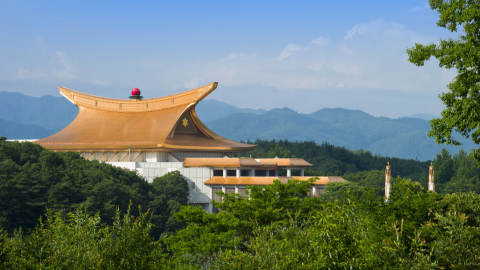
Every morning and evening Rinko performs a prayer. Every day she also takes a walk around her house projecting the healing light. She raises her hand toward the objects in her house, such as her refrigerator. Once a month, members gather at a worship building. There they pray aloud all together to align their hearts to God and they also listen to a speech from the leader of the religion. Twice a year a performance is held where youth wear special uniforms and music performances and dances are conducted. Members hold these events for God to show their dedication and to receive the power of God.
According to Rinko, Sukyo Mahikari is a small, but worldwide religion founded in Tokyo, Japan. The founder, Okada, had been considering committing suicide because of hardships in his life. He had just lost his company and his body wasn’t in good condition. One day he was walking around outside and suddenly heard a god tell him to extend out the palm of his hand. He didn’t understand the meaning, so he randomly placed his hand toward a dog that happened to be in the street. This dog was sick but was healed by the outreached hand, surprising the owner of the dog. Since that day, Okada started hearing the voice of the god more often and used his ability to heal people. From there a religion developed and has spread all across the world.
Information about this religion is difficult to find, but there are a couple of academic journals available. After reading these, it appears that Rinko is knowledgeable about her religion. However, there are some differences and some details that would be important to know in combination with what was explained by Rinko. For example, she stated that anyone of any religion is free to learn the healing power, be healed, or become a member. This is true, though the religion’s prayer book “contains a spell to ward off missionaries” and states that someone can’t call themselves a follower of Jesus if they haven’t learned how to perform the healing light (Young, 1990). Okada also stated that if the world wasn’t healed by the year 2000 A.D., God would “incinerate the world” (Young, 1990). That deadline has passed, so perhaps a new revelation has since been received.
The origin story of the religion, as Rinko told it, may also be slightly different. It appears that Okada has several first visions which conflict with each other. In another academic journal multiple origin stories are described. One story is that after Okada received his initial revelation, he raised his hand and made a blind person able to see and a crippled person able to walk (Broder, 2008). Another version states that he heard a voice and tested the healing light on a dog (Broder, 2008). That one more closely matches Rinko’s story, however other details she described aren’t mentioned in the journal.
As for the interview itself, it was conducted at her kitchen table. After the interview, she asked if I had any pain. I said yes, that I have back pain and she offered to perform her healing on me. She took me over to the connecting room, where she had me kneel behind her facing her back. She put her hands together prayer style and I did the same. We then clapped our hands three times and then three times bowed down forward and to the right until the tip of our hands touched the floor. Afterward we faced each other and kept our hands out in prayer form. I closed my eyes as she performed a chant. Then, keeping my eyes closed, there was silence for what felt like around five minutes. This must have been a moment of receiving the power from God. She then told me to open my eyes and lay face down on the floor, where she performed more silent healing, occasionally massaging my back, for 15-20 minutes. I haven’t experienced pain relief, but maybe it takes time. During the interview she also stated that the current virus situation was predicted by the founder when the religion started. The founder said that something bad will occur and that a lot of people will become sick.
It is a unique and interesting religion, but, like many other religions, there isn’t much evidence for the claims. The light-based healing powers, the visions, the claimed predictions by Okada are all simply statements without anything to back them up. Perhaps this religion helped provide Rinko meaning to her life and, to her, science and testing doesn’t need to be involved.
References
Young, R. F. (1990). Magic and Morality in Modern Japanese Exorcistic Technologies: A Study of Mahikari. Retrieved from https://www.jstor.org/stable/30233406?seq=1.
Broder, A. (2008). Mahikari in Context. Retrieved from https://nirc.nanzan-u.ac.jp/nfile/2962.