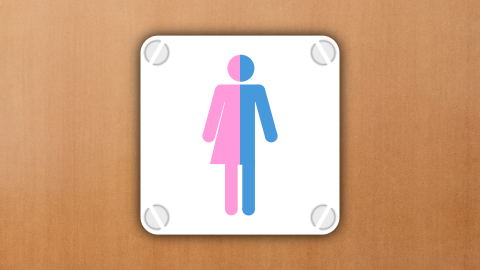
A common phrase used within the transgender community is “trans women are women”. The words man and woman have historically been associated with sex. A baby is conceived, determined during an ultrasound, or upon birth, to be a male or a female based on genitalia, and the individual goes through life being called a boy, girl, man, or woman, and he or she based upon their sex. Even in cultures where women dress and act the same as men, women are still called women because of their biology. If linking the definitions of man and woman with sex, it would be incorrect to say that trans women are women. The term trans woman becomes an oxymoron, only unless specific disorders of sex development are involved.
If associating man or woman with the social construct definition of gender, where someone is identified based on who they say they are, then transgender women could be considered women. This is because in the alternate definition of gender, the words man and woman are based on socially agreed upon definitions that include internal feelings, personality, appearance, and other ways of expression. However, this then requires distinct definitions of man and woman. These definitions can vary drastically depending on culture. A man or woman may be completely different in one culture versus another, which makes defining either one difficult. Not only must definitions be provided for man and woman, the distinction between a man and a woman must be defined for every gender culture.
Even if clear social construct gender definitions of man and woman are developed, it must be determined if the social construct is scientific reality or if it is a belief. With contradicting opinions, information, and studies, it may be too early to conclude whether the social construct of gender is based in scientific reality.7 8 For now, the focus must be on the social and cultural impacts of implementing this relatively new social construct. Cultures around the world often mix, sometimes creating complex debates as to what should be allowed from an individual culture. The transgender movement brings with it its own complexities.
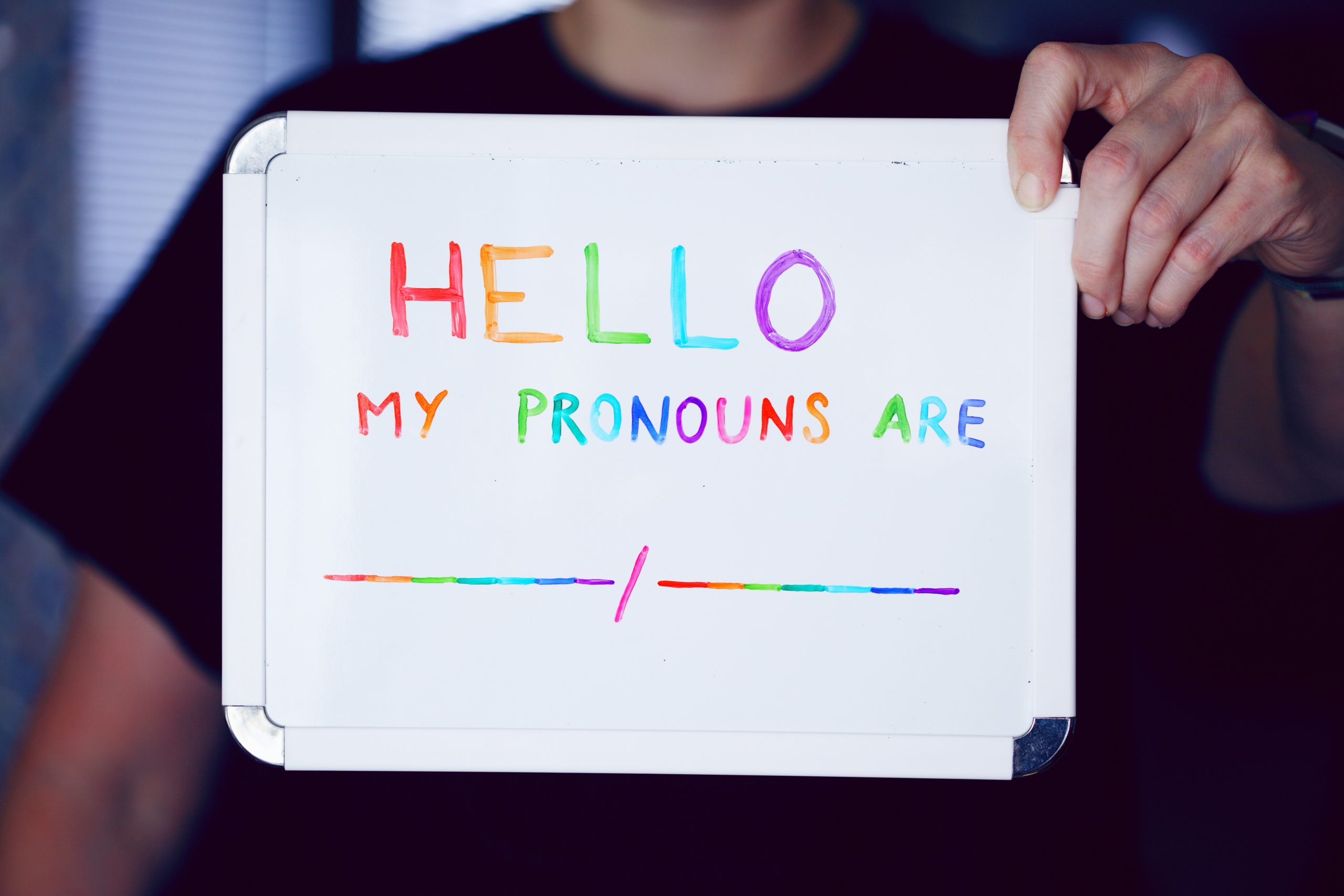
The major question is if everyone who isn’t transgender should be expected to conform to all requests of those who are transgender. One study approximates that 1.0% of the United States population identifies as transgender.9 With the transgender identifying population being such a small minority, it adds to the question whether the 99 non-transgender people should be forced to accommodate for the 1 transgender identifying person. With one side believing that pronouns and male and female identification are based on biological sex, and the other believing that it is all based on an internal identity, the issue becomes further complicated.
The transgender-aligned side states that using pronouns is simply being respectful of an individual’s gender. But what if someone doesn’t believe in the concept and instead prefers biology? Would it not be respectful to allow that person to exercise their own beliefs? Essentially, these are two incompatible belief systems. If the two sides are to peacefully coexist, all must come to an agreement toward one side or there must be a compromise.
Using only he and she for biology would be the simplest way to refer to individuals. However, the disorders of sex development can sometimes be ambiguous, so it must be determined which pronouns apply to such individuals. The two obvious options within basing pronouns on biology are to either base them on chromosomes or on outward appearance, and neither option is perfect. This is because there are individuals with chromosomes of the sex opposite to the individual’s appearance. A third option is to base pronouns on development intent. For example, XY Complete Gonadal Dysgenesis would be a male because the development was intended to be male despite the failure of the SRY gene, causing female physical characteristics. Or XX male syndrome where the development intent was female, but an SRY gene was accidentally transferred to an X chromosome sperm, causing development of male physical characteristics. Suppose an individual has external female characteristics, but male, or male intended, chromosomes. Maybe that individual will want to be called a female for not only personal reasons, but also because society will say “she” without knowing the chromosome situation.
A final option upon which to base pronouns is the possessed, or development intended, reproductive system. Males are intended to have the capability to produce sperm, and females are intended to have the capability to produce ova, or eggs, and have a uterus. Along with those capabilities come various other parts necessary for sexual reproduction. There are medical conditions that prevent the development of the ability to produce sperm or ova. Examples include anorchia, where a 46,XY male is absent of testes, or bilateral ovarian agenesis, where a 46,XX female is born without ovaries. Despite the absence of testes or ovaries, the intended development can still be pointed toward male or female. However, there is also ovotesticular disorder, where an individual is born with both ovarian and testicular tissue. Within this condition is a very rare possibility of 46,XX/47,XXY mosaicism where an individual can be born with a combination of the female uterus and fallopian tubes and the male epididymis and vas deferens. Most of these individuals are infertile, but some have been able to produce sperm or ova after surgery depending on the predominant phenotype. In one documented case, it was claimed that a phenotypical male was reported to have given birth.10
Basing pronouns on chromosomes, external appearance, or reproductive abilities is enough for the vast majority of the population, but breaks down when discussing disorders of sex development. This, however, doesn’t negate the fact that he and she applies to 99.98%+ of individuals. The basic determination could be that individuals with ambiguous disorders of sex development may choose whether they wish to be referred to as a male or a female. It could also be stated that having individually chosen pronouns for everyone also solves this ambiguity. But this wouldn’t be necessary with the simpler proposal of he and she as usual for normal individuals and a choice for individuals who are physically ambiguous. Additionally, not everyone believes in the social gender, leaving the argument at biology versus social construct.
With these two conflicting ideas, one based on biology and the other based in the mind, maybe the answer is that everyone should respect everyone else’s choice. If someone prefers to not refer to a social construct believing individual by pronouns that the individual likes, that is ok. If someone does prefer to use those pronouns, that is ok too. The negative intent versions of these, where an individual who follows social gender uses the opposite pronoun for a follower of biology, or a follower of biology secretly calls a follower of social gender by undesired pronouns out of spite, wouldn’t be ok. An implementation of this idea can already be seen within the armed forces, where Title 10 United States Code 986 states “The Secretary of Defense may not require or prohibit a member of the armed forces or a civilian employee of the Department of Defense to identify the gender or personal pronouns of such member or employee in any official correspondence of the Department.”11
Another possibility toward a solution is to use a single pronoun set. We already use they/them in passing conversation when we don’t yet know the sex/gender. The two pronouns aren’t only used when mentioning a plurality of people, as seen in the sentence “The masked intruder ran away, but I don’t know where they went.” A replacement could be made where he/him and she/her could be merged into they and them. The two could serve as all-encompassing, neutral pronouns that work for everyone, even those with ambiguous biological features. The transgender community already uses they/them as gender-neutral pronouns, but having it cover everyone would be a great way to establish neutral ground and satisfy everyone within the pronoun debate. This would prevent misgendering someone and would provide a logical set of pronouns that those on the side of linking pronouns with biology could use for others. Likewise, person could be used in place of man, woman, boy, girl, male, and female. This doesn’t mean that they/them and person should necessarily serve as replacements in all cases, but could at least solve issues during interactions between the two sides.
- https://www.pnas.org/doi/10.1073/pnas.2310012121 ↩︎
- https://www.nytimes.com/2018/12/03/opinion/male-female-brains-mosaic.html ↩︎
- https://williamsinstitute.law.ucla.edu/publications/trans-adults-united-states/ ↩︎
- https://academic.oup.com/bjs/article-abstract/69/5/279/6185759 ↩︎
- https://uscode.house.gov/view.xhtml?req=granuleid:USC-prelim-title10-section986&num=0&edition=prelim ↩︎